God — The Faces of the Infinite
Brahman, Shunyata, the Trinity, Tawhid, Ein Sof, the Tao: six names, and the same refusal to be contained.
A book by Alin Dragoș
The Essence of the Divine Teaching Through All the World’s Religions
Eleven traditions. Three thousand years. One message that survives every translation.
The light of today
The light of today, every morning on your phone.
Get it on Google PlayThe premise
This book belongs to no religion, and it belongs to them all. It was not written for believers or for unbelievers, but for human beings — those who breathe, who suffer, who love, and who search for a meaning beyond the noise of the world.
All who seek arrive, in the end, at the same Light — even when they set out in opposite directions.
This book follows these golden threads through the labyrinth of the spiritual traditions, showing how each religion is, in its essence, a unique path toward the same unseen mountain.
Read with an open heart. Not in order to believe something new, but in order to remember what you already know in the depths of your being.
Eight chapters
Brahman, Shunyata, the Trinity, Tawhid, Ein Sof, the Tao: six names, and the same refusal to be contained.
From agape to metta to Ubuntu — why every tradition ends up calling love the structure of reality.
Dukkha, the Cross, karma, Tikkun Olam: four ways of turning a wound into a doorway.
Advaita says Self, Buddhism says no-self — and both arrive at the same silence.
Rebirth, resurrection, nirvana, Barzakh: nowhere on earth is death the last word.
Prayer, meditation, service, study — the four practices every tradition arrived at on its own.
Samadhi, Satori, Fana, Devekut: the one experience that came before every theology.
Seven pillars and five revelations — what remains once the names are set aside.
A passage
Chapter I
What is God? Perhaps the boldest question the human mind has ever asked itself. And perhaps the most dangerous — not because it might destroy faith, but because any answer formulated in words risks reducing the Infinite to the narrow dimensions of language.
And yet every tradition has dared. And in their daring, paradoxically, they said the same essential thing: God is beyond all definitions, and at the same time nearer to you than your own breath.
If you know yourself, you know God.
Jesus Christ — The Gospel of Thomas
Atman is Brahman — the individual self is the Universal Self.
The Upanishads, Hinduism
He who knows himself knows his Lord.
Hadith attributed to the Prophet Muhammad
The differences are not, in essence, about Reality, but about the way human consciousness — culturally and linguistically conditioned — articulates the experience of contact with it. All the maps point to the same territory. And none of the maps is the territory.
When a Christian and a Buddhist meditate together, nothing theologically alarming occurs. Something profoundly human and universal occurs: two consciousnesses step out of the daily clamor and turn toward their own depth. And in that depth — they find each other.
The synthesis
Beneath the apparent multiplicity of the world pulses a Unitary Reality — whether we call it Brahman, Allah, God, Tao, Dharmakaya or the Great Spirit. Separation is a limited perspective, not an ultimate ontological fact. All authentic spirituality leads, in the end, to the experience of this unity.
Ultimate reality is not matter that produces consciousness, but consciousness that produces the appearance of matter — or, more precisely: the matter-consciousness dualism is itself a limited perspective. The mystery of consciousness is the mystery of the divine.
The divine spark, Atman, Buddha nature, the Image of God — every tradition affirms that the human being is not merely a creature, but the bearer of a divine potential. Spiritual realization adds nothing new — it reveals what is already present.
Not a law imposed from outside, but the ontological structure of reality. The universe functions on the basis of interrelation, interdependence, communion. Resistance to love is resistance to one’s own deepest nature.
No authentic tradition ignores suffering, minimizes it or offers simplistic solutions. All offer something more precious: a framework in which suffering becomes purifying, transformative, the most effective instrument for the growth of consciousness.
Not slow biological evolution, not gradual social change — but radical transformation, now, through sustained spiritual practice. All traditions affirm that a human being can become other than what he is. That what seems fixed and immutable — the ego, the limits, the fear — can be transcended.
Whether it is formulated as reincarnation, resurrection, nirvana or continuation in God — all traditions affirm that consciousness is not extinguished together with the physical body. The foundation of this conviction is not the fear of death, but the direct experience of dimensions of consciousness that appear to transcend the limits of time and space.
The essential message
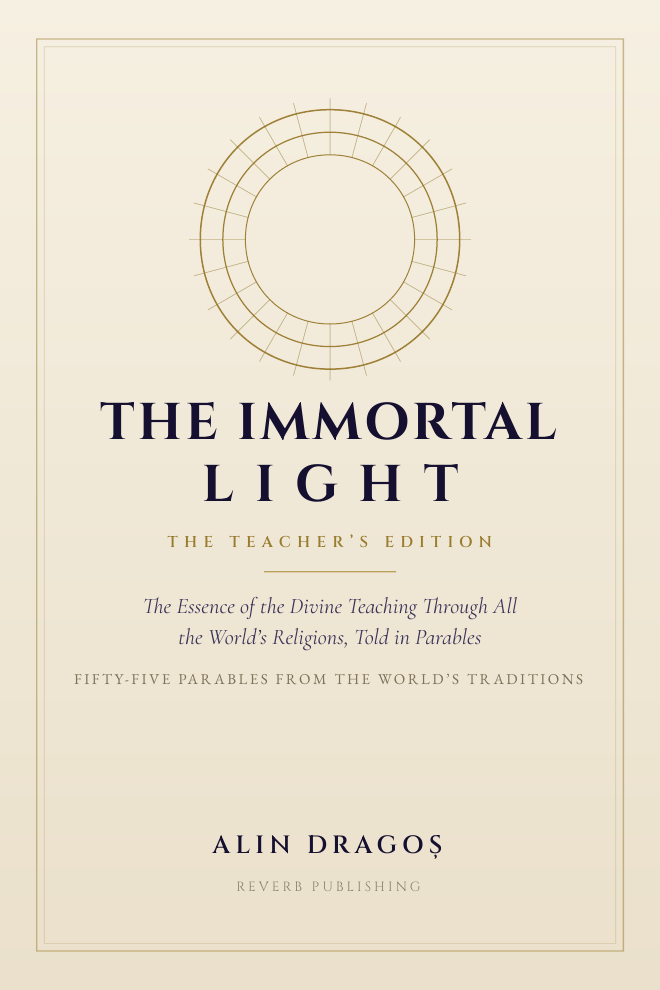
The second book
The same eight themes — and beside each one, a parable from the tradition that is speaking: retold in full, then followed by what the parable knows and an argument cannot say.
A printable PDF, delivered the moment you buy it. Every source is named, and the full list of the parables and where they come from closes the book.
The first book
Printed edition, in the typography it was designed for.
See the editionThe whole book on the device you already carry.
See the editionThe premium edition of the first book — read it tonight, or print it yourself.
See the editionThe lines from this page, set for the wall.
See the editionIn English and in Romanian, in preparation. The Teacher’s Edition above is the one you can read tonight.